
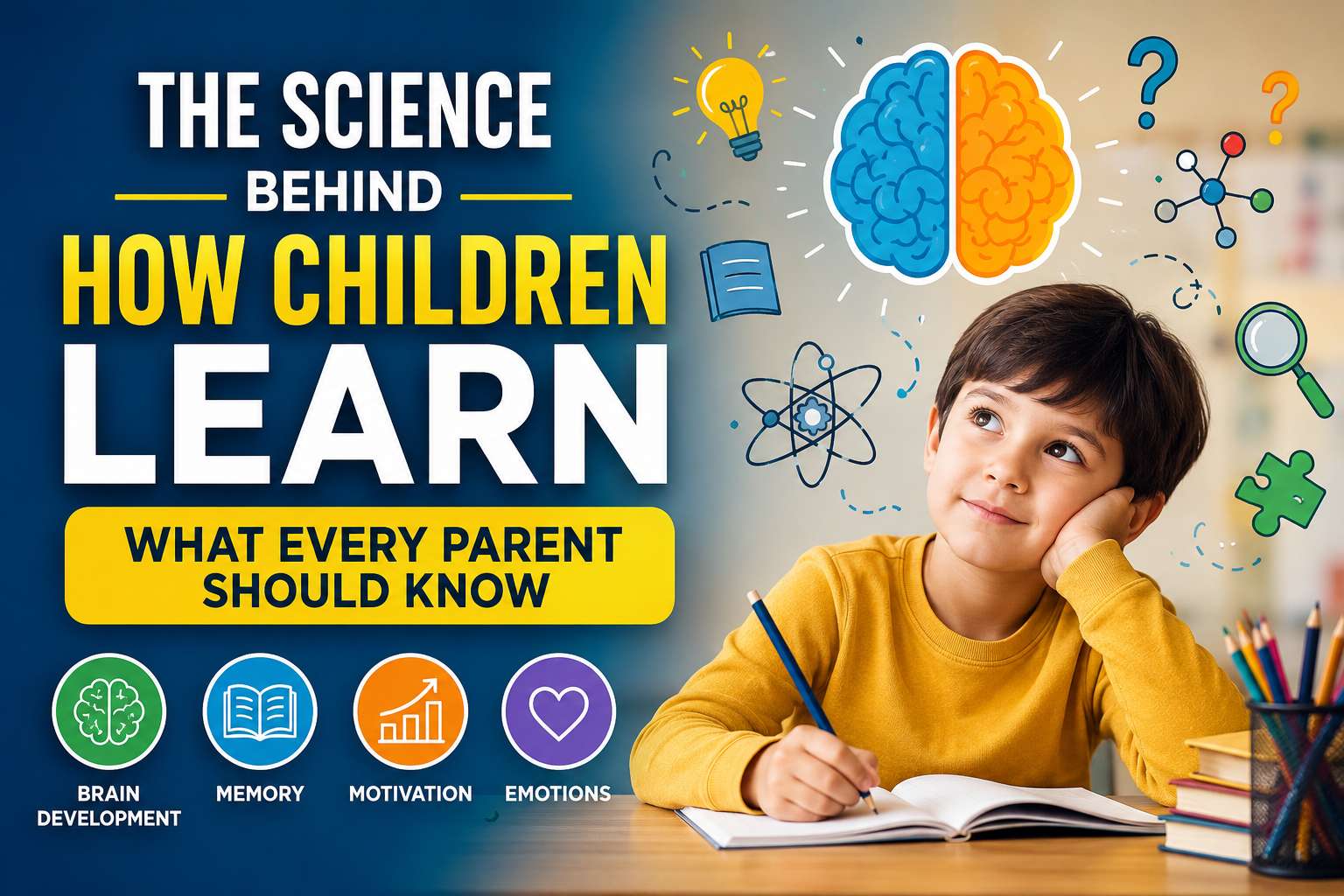
The Science Behind How Children Learn: What Every Parent Should Know
Every child enters the world with an incredible ability to learn. From recognizing a parent’s voice as a baby to solving complex mathematical problems during adolescence, learning is a lifelong journey that begins from the very first day of life. But have you ever wondered how children actually learn? Why does one child quickly understand a concept while another needs more time? Why do some children love reading while others prefer experiments, sports, or art?
The answers lie in the fascinating science of how the human brain develops and processes information.
Modern educational research has transformed our understanding of learning. Experts now know that successful learning is not simply about memorizing facts or achieving high examination scores. Instead, learning is a dynamic process influenced by brain development, emotions, environment, relationships, nutrition, sleep, motivation, curiosity, and meaningful experiences.
For parents, understanding the science behind learning is invaluable. It allows them to create supportive environments where children thrive academically, emotionally, socially, and creatively. Rather than focusing only on marks, parents can nurture confidence, resilience, problem-solving abilities, and a genuine love for learning.
At STXPBH School, we believe education extends beyond textbooks. Our goal is to help every child develop the knowledge, skills, values, and curiosity needed to succeed in school and throughout life. By combining innovative teaching methods with a caring environment, we strive to unlock every student’s unique potential.
This comprehensive guide explores the fascinating science behind how children learn and offers practical strategies that parents can use to support their child’s educational journey.
Table of Contents
- Understanding the Science of Learning
- How a Child’s Brain Develops
- Neuroplasticity: The Brain’s Ability to Grow
- Why Curiosity Is the Foundation of Learning
- The Role of Memory in Learning
- How Attention and Focus Affect Academic Success
- Why Emotions Influence Learning
- Every Child Learns Differently
- Learning Through Play
- The Importance of Reading
- Sleep and Brain Development
- Nutrition and Learning Performance
- Physical Activity and Cognitive Growth
- Technology in Modern Education
- Developing Critical Thinking Skills
- Building Emotional Intelligence
- Encouraging a Growth Mindset
- Creating the Ideal Learning Environment at Home
- How Schools Support Effective Learning
- How Parents and Teachers Can Work Together
- Frequently Asked Questions
- Conclusion
Understanding the Science of Learning
Learning is much more than remembering facts for an examination. It is a continuous process where the brain receives information, processes it, stores it, and applies it in different situations.
Scientists describe learning as the formation of new neural connections inside the brain. Every new experience—whether reading a book, playing a game, solving a puzzle, or having a conversation—creates pathways between brain cells. The more these pathways are used, the stronger they become.
This explains why practice is so important. Repetition strengthens connections, making information easier to recall and apply later.
Learning is influenced by several factors, including:
- Brain development
- Emotional well-being
- Physical health
- Family environment
- School environment
- Teaching methods
- Motivation
- Curiosity
- Social interactions
- Real-life experiences
Understanding these factors helps parents appreciate that learning is a holistic process rather than simply completing homework or scoring marks.
How a Child’s Brain Develops
A child’s brain develops faster during the early years than at any other stage of life. By the age of five, nearly 90% of the brain’s growth has already occurred.
Every experience contributes to brain development.
Simple daily activities such as:
- Listening to stories
- Playing with toys
- Asking questions
- Talking with parents
- Exploring nature
- Singing songs
- Drawing pictures
- Building blocks
help create millions of neural connections.
Positive experiences strengthen these connections, while repeated practice makes them permanent.
This is why early childhood education plays such an important role in lifelong learning.
Neuroplasticity: The Brain’s Amazing Ability to Learn
One of the most exciting discoveries in neuroscience is neuroplasticity.
Neuroplasticity refers to the brain’s ability to change, reorganize, and strengthen itself throughout life.
For children, this means:
- Intelligence is not fixed.
- Skills improve with practice.
- Mistakes help the brain learn.
- Every challenge strengthens understanding.
Children are not born “good” or “bad” at subjects.
Instead, consistent learning experiences gradually develop knowledge and abilities.
Parents who encourage effort instead of perfection help children develop confidence and resilience.
Why Curiosity Is the Beginning of Learning
Children are naturally curious.
Questions such as:
- Why is the sky blue?
- How do birds fly?
- Why do stars shine?
- What makes plants grow?
are signs of healthy brain development.
Curiosity motivates children to investigate, experiment, and discover.
Instead of immediately giving answers, parents can ask:
- What do you think?
- How could we find out?
- Let’s explore together.
This approach develops:
- Independent thinking
- Creativity
- Scientific reasoning
- Problem-solving skills
- Confidence
Schools that encourage inquiry-based learning often produce students who enjoy lifelong learning.
How Memory Helps Children Learn
Memory is one of the most important components of learning.
The learning process generally follows three stages:
1. Encoding
The brain receives new information through:
- Seeing
- Hearing
- Reading
- Touching
- Doing
2. Storage
The brain organizes information into short-term and long-term memory.
3. Retrieval
Children recall stored information when solving problems, answering questions, or applying knowledge.
Parents can strengthen memory by encouraging:
- Reading daily
- Regular revision
- Practical activities
- Educational games
- Storytelling
- Hands-on learning
The Importance of Attention and Concentration
Attention is the gateway to learning.
Without focus, information rarely reaches long-term memory.
Children’s concentration depends on:
- Age
- Interest
- Sleep
- Nutrition
- Stress levels
- Learning environment
Simple ways parents can improve concentration include:
- Maintaining study routines
- Reducing distractions
- Limiting unnecessary screen time
- Creating organized study spaces
- Encouraging short breaks between study sessions
Quality study is always more effective than long hours of unfocused learning.
How Emotions Affect Learning
Children learn best when they feel emotionally safe.
Positive emotions improve:
- Memory
- Creativity
- Motivation
- Confidence
- Classroom participation
Negative emotions such as fear, anxiety, and excessive pressure can reduce the brain’s ability to absorb information.
Parents and teachers should focus on encouragement instead of criticism.
Celebrating effort rather than only results helps children remain motivated and willing to face challenges.
Every Child Learns in a Unique Way
No two children learn exactly the same way.
Some children understand concepts by reading.
Others learn through observation, discussion, experiments, or practical activities.
Each child has different:
- Interests
- Talents
- Learning pace
- Personality
- Experiences
Comparing children with one another often reduces confidence.
Instead, parents should recognize individual strengths and encourage steady progress.
A supportive learning environment allows every child to develop at their own pace.
Learning Through Play
Play is not separate from learning—it is one of the most effective ways children develop important skills.
Through play, children improve:
- Language skills
- Creativity
- Social interaction
- Problem-solving
- Decision-making
- Emotional regulation
- Teamwork
Activities such as building blocks, role-playing, puzzles, outdoor games, and storytelling stimulate multiple areas of the brain simultaneously.
At STXPBH School, play-based learning in the early years encourages curiosity while building strong academic foundations.
The Importance of Reading Every Day
Reading is one of the strongest predictors of academic success.
Children who develop regular reading habits often have:
- Better vocabulary
- Stronger comprehension
- Improved writing
- Greater imagination
- Enhanced concentration
- Higher confidence
Parents can encourage reading by:
- Creating a home library
- Reading together daily
- Discussing stories
- Allowing children to choose books based on their interests
Even 20 minutes of reading every day can make a remarkable difference over time.
Why Sleep Is Essential for Learning
Many parents underestimate the importance of sleep.
During sleep, the brain:
- Organizes memories
- Processes new information
- Strengthens neural connections
- Restores mental energy
Children who sleep well generally perform better academically, demonstrate improved attention, and manage emotions more effectively.
Establishing consistent bedtime routines contributes to healthier brain development.
Nutrition: Fuel for the Growing Brain
The brain requires proper nutrition to function effectively.
A balanced diet supports:
- Memory
- Attention
- Energy
- Cognitive development
Healthy meals should include:
- Fruits
- Vegetables
- Whole grains
- Dairy products
- Protein
- Healthy fats
Adequate hydration is equally important since even mild dehydration may reduce concentration.
Healthy eating habits developed during childhood often continue throughout adulthood.
How Physical Activity Improves Learning
Exercise benefits both physical and mental health.
Regular physical activity increases blood flow to the brain, improving concentration and memory.
Sports also teach valuable life skills such as:
- Leadership
- Discipline
- Teamwork
- Time management
- Resilience
Students who participate in sports often demonstrate improved classroom engagement and confidence.
Technology in Modern Learning
Technology has become an important educational tool.
Interactive applications, virtual simulations, educational videos, coding activities, and digital collaboration platforms can enhance understanding.
However, balance remains essential.
Parents should encourage:
- Educational screen time
- Safe internet practices
- Offline learning activities
- Family discussions about responsible technology use
Technology should support—not replace—human interaction and practical experiences.
Developing Critical Thinking Skills
The future belongs to children who can think independently.
Critical thinking enables students to:
- Analyze information
- Solve problems
- Evaluate evidence
- Make informed decisions
- Develop innovative ideas
Parents can encourage critical thinking by asking open-ended questions and allowing children to explain their reasoning.
Building Emotional Intelligence
Academic knowledge alone is no longer enough.
Children also need emotional intelligence to succeed in relationships, education, and future careers.
Emotional intelligence includes:
- Self-awareness
- Empathy
- Communication
- Self-control
- Relationship-building
Schools and families should work together to nurture these essential life skills.
Encouraging a Growth Mindset
A growth mindset teaches children that abilities improve through effort.
Instead of saying:
“I can’t do this.”
Children learn to say:
“I can’t do this yet.”
Parents can reinforce a growth mindset by praising:
- Hard work
- Persistence
- Improvement
- Curiosity
- Courage to try again
This mindset builds resilience and lifelong confidence.
Creating the Ideal Learning Environment at Home
Parents play a crucial role in education.
Simple habits make a lasting impact:
- Maintain daily routines.
- Encourage questions.
- Read together.
- Celebrate effort.
- Create quiet study spaces.
- Limit distractions.
- Spend quality family time.
- Encourage hobbies.
- Support healthy lifestyles.
Learning should continue beyond the classroom.
How Schools Support Effective Learning
A quality school creates an environment where children feel safe, respected, and inspired.
Effective schools provide:
- Qualified teachers
- Modern classrooms
- Well-equipped libraries
- Science and computer laboratories
- Sports facilities
- Creative arts programs
- Technology-enabled learning
- Character education
- Student well-being initiatives
At STXPBH School, our focus is on creating meaningful learning experiences that encourage academic excellence while fostering creativity, confidence, discipline, and compassion. We believe every child deserves an education that prepares them not only for examinations but also for life.
How Parents and Teachers Can Work Together
Successful education is a partnership.
Regular communication between parents and teachers helps identify strengths, address challenges, and support continuous improvement.
Parents can:
- Attend parent-teacher meetings.
- Monitor progress positively.
- Encourage consistent study habits.
- Communicate concerns openly.
- Celebrate achievements together.
When schools and families work as a team, children receive consistent guidance and encouragement.
Frequently Asked Questions
How do children learn most effectively?
Children learn best through active participation, curiosity, meaningful experiences, practice, encouragement, and supportive relationships.
Why is play important for learning?
Play develops creativity, communication, emotional intelligence, teamwork, and problem-solving while making learning enjoyable.
Can intelligence improve over time?
Yes. Research on neuroplasticity shows that the brain continues developing through practice, effort, and positive learning experiences.
How can parents support learning at home?
Parents can encourage reading, maintain routines, provide emotional support, ask thoughtful questions, create quiet study spaces, and celebrate effort rather than only results.
Why are sleep and nutrition important for learning?
Healthy sleep and balanced nutrition improve memory, concentration, emotional regulation, and overall brain development.
Conclusion
Understanding the science behind how children learn empowers parents to become active partners in their child’s educational journey. Learning is not limited to classrooms or examinations—it is a lifelong process shaped by curiosity, meaningful experiences, supportive relationships, healthy habits, and opportunities to explore the world with confidence.
Every child has unique strengths, interests, and abilities. By recognizing these differences and creating environments where curiosity is encouraged, mistakes are accepted as opportunities for growth, and effort is celebrated, parents and educators can help children unlock their full potential.
At STXPBH School, we are committed to providing an environment where academic excellence goes hand in hand with creativity, character, confidence, and lifelong learning. Together with parents, we strive to nurture curious minds, compassionate hearts, and responsible future leaders who are prepared to thrive in an ever-changing world.
If you are looking for a school that values holistic development, innovative learning, and a supportive educational community, we welcome you to explore what STXPBH School has to offer. Together, we can lay the foundation for your child’s bright and successful future.